

The Future of Cylindrical Cell Assembly Machines: Trends, AI Integration, and Smart Manufacturing
Introduction: Why Cylindrical Cell Assembly Is at a Turning Point
Growth in global demand for cylindrical lithium-ion batteries driven by EVs, ESS, and power tools
Shift from cost-focused manufacturing to quality-, safety-, and data-driven production
Limitations of traditional assembly machines: manual intervention, rigid tooling, offline inspection
Thesis statement: future cylindrical cell assembly machines will evolve from automation tools into intelligent manufacturing systems

Industry and Market Forces Driving Change
Adoption of Large-Format Cylindrical Cells (e.g., 4680)
Structural and thermal differences compared to 18650/21700 cells
Increased current loads and thicker tabs requiring advanced welding solutions
Equipment rigidity, clamping force, and precision challenges
Rising Quality, Safety, and Traceability Requirements
Automotive-grade quality expectations (zero-defect mindset)
Cell-level traceability and regulatory compliance
Impact of failures: recalls, brand damage, liability
Cost Pressure and Demand for Manufacturing Flexibility
Need to handle multiple cell formats on one line
Reduced product life cycles and faster model iteration
Labor shortages and rising operational costs

Evolution of Cylindrical Cell Assembly Machine Architecture
From Semi-Automatic to Fully Automated and Lights-Out Production
Reduction of manual loading, welding, and inspection
Integration of robotics and automated material handling
Implications for workforce structure and skills
Modular, Reconfigurable Assembly Line Design
Tooling modularization for rapid changeover
Independent stations that can be upgraded or replaced
Scalability: adding capacity without redesigning entire lines
Higher-Speed, Higher-Precision Motion Systems
Advanced servo systems and linear motors
Synchronization between feeding, welding, and inspection
Balancing speed increases with vibration and thermal stability
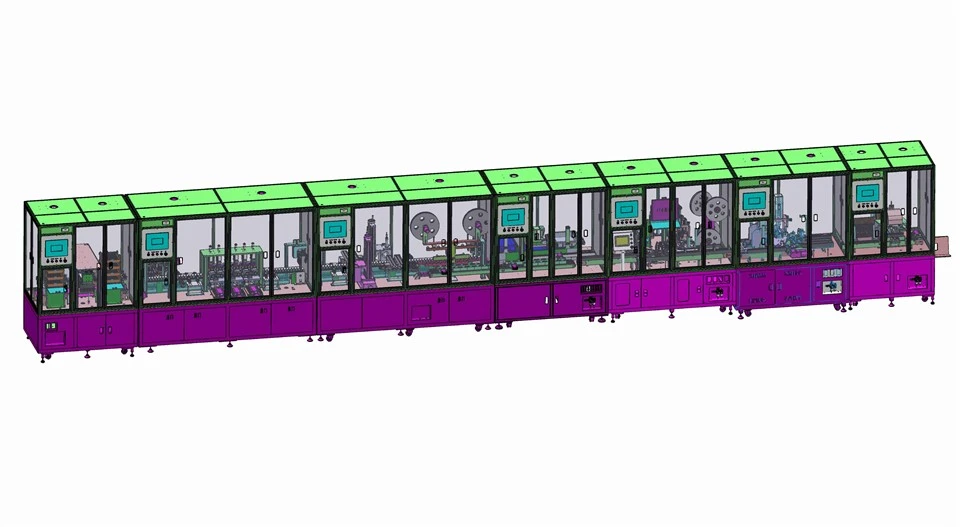
AI Integration: Transforming Assembly Machines into Intelligent Systems
AI-Based Machine Vision for Quality Inspection
Limitations of traditional rule-based vision systems
Deep learning models for weld seam analysis, misalignment detection, and insulation defects
Training data requirements and continuous model improvement
Impact on false rejects and missed defects
Intelligent Welding Control and Process Optimization
Real-time monitoring of welding energy, resistance, and temperature
AI algorithms adjusting parameters on a per-weld basis
Closed-loop feedback from inline inspection
Benefits for consistency and reduced thermal damage
Predictive Maintenance and Failure Prevention
Monitoring wear of electrodes, laser optics, actuators, and bearings
Using sensor data and historical patterns to forecast failures
Reducing unplanned downtime and maintenance costs
Integration with spare-parts planning

Smart Manufacturing and Industry 4.0 Integration
Digital Twins for Cylindrical Cell Assembly Lines
Creating virtual replicas of physical assembly machines
Simulating thermal behavior, throughput, and failure modes
Using digital twins for line optimization and changeover testing
MES, ERP, and Factory-Wide Data Connectivity
Cell-level, weld-level, and batch-level data tracking
Real-time dashboards for production monitoring
Traceability from raw cells to finished battery packs
Data-Driven Process Improvement and SPC
Applying statistical process control across the entire assembly line
Detecting drifts in welding quality or alignment accuracy
Using analytics to refine tolerances and reduce scrap

Advanced Welding Technologies Defining the Next Generation
High-Power and Ultra-Short Pulse Laser Welding
Reducing heat-affected zones while maintaining joint strength
Welding thicker tabs and multiple-layer connections
Equipment and safety implications
Hybrid Welding Solutions
Combining laser and resistance welding for specific applications
Addressing challenges in large-format cylindrical cells
Case examples of improved reliability
Thermal Management during Assembly
Controlling heat accumulation across dense cell packs
Cooling fixtures and thermal monitoring
Preventing long-term cell degradation
Robotics and Human–Machine Collaboration
Industrial Robots in Cell Handling and Assembly
Multi-axis robots for flexible positioning and welding
Advantages over fixed mechanical transfer systems
Collaborative Robots (Cobots) in Mixed Production Environments
Supporting semi-automatic lines and small-batch production
Safety systems and human–robot interaction
Autonomous Material Handling
AGVs and AMRs for cell and module transport
Integration with scheduling and production planning systems

Sustainability and Energy Efficiency in Assembly Machine Design
Reducing energy consumption per welded joint
Optimizing compressed air and cooling systems
Designing machines for long service life and upgradability
Supporting sustainability goals and ESG reporting
Key Challenges and Barriers to Smart Assembly Adoption
High Capital Investment and ROI Considerations
Balancing short-term cost with long-term competitiveness
ROI calculation models for automation and AI
Data Quality and AI Model Reliability
Importance of clean, labeled, and consistent data
Managing model drift and retraining
System Integration Complexity
Coordinating equipment, software, and third-party systems
Avoiding vendor lock-in
Cybersecurity and Data Protection
Protecting intellectual property and production data
Secure industrial networks

Strategic Recommendations for Battery Manufacturers and Equipment Buyers
Developing a phased automation and digitalization roadmap
Prioritizing high-impact use cases (inspection, welding, maintenance)
Evaluating suppliers on software capability, not just hardware
Investing in workforce training and data literacy
Practical Case Scenarios and Use Examples
Case 1: AI Vision Reducing Weld Defect Rates
Baseline defect levels vs. post-AI implementation
Measured improvements in yield
Case 2: Predictive Maintenance Preventing Production Stops
Failure prediction timelines
Impact on OEE and maintenance costs
Case 3: Flexible Lines Enabling Faster Product Transitions
Time saved during changeovers
Reduced downtime between product models
Future Outlook: What Cylindrical Cell Assembly Lines Will Look Like in 5–10 Years
Fully autonomous, self-optimizing assembly lines
Greater standardization across equipment platforms
Deeper integration of AI, robotics, and digital manufacturing
Implications for global battery manufacturing competitiveness
Conclusion: From Automation to Intelligence
Recap of key trends, technologies, and strategies
Why intelligent assembly systems are becoming essential, not optional
Final thoughts on long-term investment, scalability, and resilience