

If you've ever picked up a 9V battery-whether for a smoke detector, a guitar pedal, or a portable power tool-you probably haven't stopped to think about all the steps that go into turning raw materials into that compact, reliable power source. As a supplier of 9V battery assembly lines, I get to see firsthand how the material handling systems in these lines aren't just support components; they're the backbone of consistent, high-volume production. A 9V battery's unique design-two vertical 4.5V cells side-by-side, wrapped in a PVC jacket with metal terminals-means its assembly requires material handling that's precise, fast, and tailored to avoid the tiny defects that can drain performance or lead to failures. Today, I want to break down the key material handling systems in a typical 9V battery assembly line, why each matters, and how choosing the right setup can make or break a battery manufacturer's efficiency.
Let's start with the most basic, yet critical, stage: inbound material handling. Before any assembly begins, you have to get all the individual components to the line without damaging them. For 9V batteries, the core components are small, delicate, and often sensitive to contamination: the anode and cathode foils, electrolyte, separator sheets, metal terminals, PVC jackets, and the plastic spacer that separates the two cells. Without a solid inbound material handling system, even the highest-quality raw materials can be ruined before they reach the production floor.
In my work with manufacturers, I see two main inbound handling setups that work well. First, for foils and separators, which come in large rolls, automatic roll uncoilers with tension control are non-negotiable. If a foil roll is fed with too much tension, it can stretch, tear, or develop microscopic creases that reduce its ability to hold charge. Too little tension, and the material wrinkles, leading to misalignment during cell winding or stacking. Most modern lines use motorized uncoilers that adjust tension in real time, paired with guided rollers that keep the roll centered as it feeds-no more manual adjustments that slow production or cause errors. For smaller parts like terminals and spacers, vibratory feeders are the go-to. These gently move parts from bulk bins into a single-file line, orienting them correctly so they're ready for the next step. A bad vibratory feeder can jam, damage small terminals, or misalign parts, so we always specify feeders with adjustable amplitude and variable speed to match the line's production rate.
Next, we move to the cell assembly stage, where material handling becomes even more precise, since the cells are the heart of the 9V battery. Most 9V batteries use either wound cylindrical cells or prismatic cells, depending on the manufacturer, and both require handling that prevents damage to the active materials. For wound cells, after winding the foil, separator, and core, the material handling system has to transfer the finished cell cores to electrolyte filling stations without jostling them. That's where pick-and-place robotic arms come in, not the clunky ones you might see in old factories, but vision-guided robots that use cameras to identify each cell, grip it with a soft, non-conductive gripper, and place it accurately-within a fraction of a millimeter. For prismatic cells, which are flat and boxy, vacuum suction cups work well, as long as they're designed to avoid leaving marks on the cell surface that could lead to corrosion later.
One of the biggest challenges in cell handling is electrolyte, a flammable, corrosive liquid that can ruin equipment if spilled. So material handling here also includes sealed, closed-loop transfer systems. Instead of pouring electrolyte manually, automated pumps transfer exact amounts (measured to within microliters) from storage tanks to each cell, with sensors that shut off flow if there's a leak. This not only keeps workers safe but also reduces material waste-something every manufacturer cares about, especially when electrolyte is a specialized chemical.
Once the cells are filled with electrolyte, they go through a formation stage, where they're charged and discharged for a short time to activate the chemical reaction. After formation, the cells need to be moved to the next stage, which is combining them into the 9V's dual-cell configuration. This is where a lot of lines start to differ, and where the right material handling system can make a huge difference in speed and consistency. For standard production rates, most 9V battery assembly lines use a conveyor system with indexed stations-meaning the conveyor moves one cell pair at a time to each process step. But for manufacturers looking to scale, a high speed assembly line might use linear motors instead of traditional belts, reducing vibration and allowing for faster transfer between stations. For context, a standard line might produce around 1,000 9V batteries per hour, while a high speed line can hit 3,000 or more, and the material handling is the reason for that jump. You can learn more about these setups by checking out our line offerings: 9v Battery Assembly Line and 9v Battery High Speed Assembly Line.
Combining the two cells is another key material handling step. Each cell has a positive and negative terminal, so they have to be aligned perfectly to ensure the correct electrical connection, and then welded together (usually with spot welding, which is common in 9V production). The material handling system here has to hold both cells securely while the weld is applied-too much pressure, and the cell can rupture; too little, and the weld is weak, leading to high resistance. We use custom-designed fixtures here, machined to match the exact size of the cell cores, with spring-loaded holders that apply consistent pressure. The fixtures are also indexed, so they move the cell pairs from welding to the next station without shifting, ensuring that when the terminals are attached, they line up exactly where they need to be. Which brings us to the terminal assembly stage.
The metal terminals on a 9V battery are the customer's first point of contact, so their placement and connection have to be perfect. Most 9V batteries have a spring-loaded positive terminal and a flat negative terminal, both made of brass or steel to resist corrosion. Material handling for terminals here involves two parts: first, feeding the terminals into position, and second, moving the assembled cell pair to a terminal crimping or welding station. For this, we often use linear transfer systems that move the cell pairs from the combining station directly to terminal placement, using track rollers that reduce friction and keep the path straight. Terminals are placed either by pick-and-place robots or by automated crimping tools that press them into place with consistent force-no more uneven crimps that can lead to loose connections or failed batteries.
Once the terminals are attached, the next step is sealing the battery and placing it into the PVC jacket. This is where material handling has to be careful, because the PVC jacket is thin and can tear if handled roughly. Most lines use vacuum transfer here, moving the assembled battery from the terminal station to a jacket loading station, where the jacket is slipped over the battery. The jackets are usually fed from stacks of pre-cut PVC sleeves, so a sheet feeder or vibratory feeder moves the jackets into position, and a robotic arm stretches them just enough to slide over the battery without tearing. After the jacket is in place, the battery goes through a heat sealing station, where the ends of the PVC are crimped and sealed to protect the internal components. The material handling here has to move the sealed batteries out of the heat station quickly, because the PVC is still warm and pliable-if it sits too long, it can deform.
Finally, we get to the finished battery handling stage, which includes testing, packaging, and palletizing. Testing is a critical quality control step: each 9V battery is checked for voltage, resistance, and leakage, and any defective units are sorted out. Material handling here uses sorting systems that work with sensors: if a battery fails a test, a pneumatic arm pushes it off the main conveyor into a reject bin, while good batteries move on to packaging. For packaging, most lines use custom cartoners that fold cardboard boxes and place the batteries inside, either individually or in multi-packs. For high volume production, automated palletizing robots stack the finished boxes onto pallets, wrapped in stretch film to secure them for shipping. This end-of-line material handling is important because it reduces labor costs and ensures that finished batteries are handled consistently, reducing the risk of damage during storage or transport.
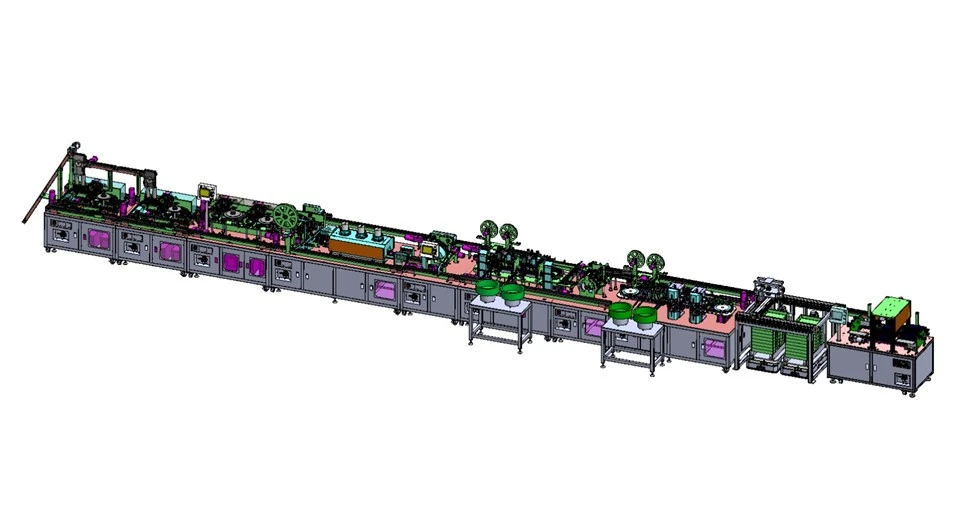

But here's what many new battery manufacturers don't realize: a material handling system isn't just a set of machines-it's integrated with the entire assembly line. For example, if your line is designed for high speed, the material handling has to sync with every other station, so a slow conveyor or a misaligned pick-and-place robot can bottleneck the entire process. That's why when we design a 9V battery assembly line, we don't just sell individual components-we work with manufacturers to map out every step, from inbound materials to finished pallets, to make sure the material handling is tailored to their production goals. Whether you're a small manufacturer just starting out or a large facility scaling production, the right material handling can cut down on defects, reduce downtime, and increase your overall output.
If you're a battery manufacturer looking to upgrade your assembly line or set up a new production facility, the material handling system is one of the most important investments you can make. A poorly designed material handling system can lead to higher defect rates, more downtime, and higher labor costs, while a well-designed one can help you produce consistent, high-quality 9V batteries at scale. If you'd like to discuss your specific production needs, including options for standard or high speed lines, we're here to help.
References:
- Battery Manufacturing Association. (2022). Material Handling Best Practices for Small and Large Format Battery Assembly. Retrieved from industry technical guidelines.
- International Electrotechnical Commission (IEC). (2021). Standard 60086: Primary Batteries – Part 1: General. Technical Specifications for Battery Assembly and Handling.
- Global Battery Alliance. (2023). Sustainable Material Handling in Battery Production: Reducing Waste and Ensuring Safety. Industry Report.